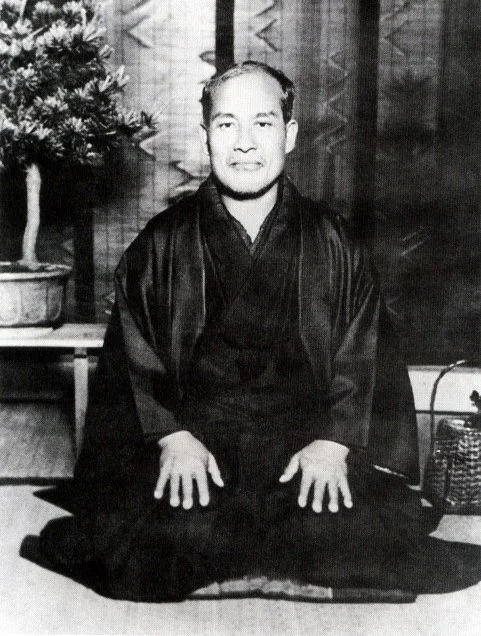
Founder of Aikido
Ueshiba Morihei
Ueshiba Morihei (1883-1969) was born in the small port town of Tanabe (present-day Wakayama Prefecture) on December 14, 1883. Known as O-Sensei or “Great Teacher” to aikido practitioners worldwide, Ueshiba Morihei is credited with developing Japan’s spiritual martial art. Having a weak constitution as a child, Ueshiba set out to develop his body and eventually became known for his great strength. Although exposed to various martial disciplines from an early age, Ueshiba’s first formal martial arts study was in Tenjin Shin’yo-ryu Jujutsu under Tokusaburo Tozawa in 1901 at age 17. Shortly after he began training, Ueshiba contracted Beriberi and was forced to leave Tokyo, returning home to Tanabe.
In 1903, Ueshiba enlisted in the 61st Army Infantry Regiment of Wakayama and served during the Russo-Japanese War. During the war, Ueshiba trained in Jukenjutsu (bayonet techniques) and studied Goto-ha Yagyu Shingan-ryu Jujutsu under Masakatsu Nakai from 1903 to 1908. Ueshiba went on to briefly study Kodokan Judowith Kiyoichi Takagi (1911) and in 1915 met Sokaku Takeda of the Daito-ryu.
Upon meeting Takeda Sokaku, Ueshiba devoted himself to learning the secrets of Daito-ryu Jujutsu and later became known as one of Takeda’s most distinguished students. Much has been said about the connection between Daito-ryu and Ueshiba’s modern aikido. Through research, it has become quite clear that the main technical influence in the development of modern aikido were the teachings of Takeda Sokaku.
Ueshiba Morihei was a devout student of Takeda Sokaku from 1915 to 1937 and received the following Daito-ryu scrolls: hiden mokuroku, hiden ogi, and goshin’yo no te. In September of 1922, Takeda Sokaku awarded Ueshiba with the kyoju dairi (teaching license) and a densho (transmission scroll) in Shinkage-ryu Heiho (kenjutsu).
Over the next several years, Ueshiba taught Daito-ryu under the watchful eye of Takeda Sokaku. In April 1931, Ueshiba opened the Kobukan Dojo in Ushigome, Wakamatsu-cho. In 1932, Ueshiba co-founded the Dai Nihon Budo Sen’yokai in Ayabe with Omoto-kyo leader, Onisaburo Deguchi. Becoming more influenced by the philosophical teachings of the Omoto religion, Ueshiba no longer referred to his martial art as Daito-ryu, but began to identify his teachings with alternative names such as Aioi-ryu aikijujutsu, Kobu budo and aiki budo. In 1933, Ueshiba accepted an invitation from Hisa Takuma to teach martial arts at the Asahi Shimbun located in Osaka. From 1933 to 1936, Ueshiba taught jujutsu at the Asahi Shimbun and referred to his art as Dai-Nihon Asahi-ryu jujutsu. Eventually altering the teachings of Takeda Sokaku, Ueshiba went on to create a new martial art, grounded in the technical teachings of the Daito-ryu, but influenced by the teachings of Onisaburo Deguchi and the Omoto-kyo religion.
In 1942 Ueshiba Morihei sent a senior student, Hirai Minoru, to the government controlled Dai Nihon Butokukai (The Greater Japan Martial Virtues Society) as a representative of the Kobukan Dojo. The Dai Nihon Butokukai was in the process of establishing a new division within the organization to include all jujutsu based schools and generically labeled this new category “aikido." The name aikido, although a category established within the Dai Nihon Butokukai referring to all jujutsu based systems, was then used by Ueshiba to refer to his modern art. Today, the name aikido is generically used to reference the art created by Morihei Ueshiba.